
Identifying OCD in Teenage Girls: The Reality of OCD Progression in Adolescence
The signs of OCD in teenage girls may be discreet but carry significant weight. From excessive worrying to the manifestation of ritualistic behaviors, these signs carry significant weight, impacting various aspects of a teenager’s life.
Teenage girls with OCD may exhibit a range of symptoms that significantly impact their daily lives. Key symptoms include:
⦁ Intrusive Thoughts: Often involve fears about contamination, harm to loved ones, or a need for symmetry. These thoughts can be persistent and cause considerable anxiety.
⦁ Compulsive Behaviours: May include actions like excessive hand washing, meticulous checking, counting, or repeating specific actions. These behaviors are performed in an attempt to alleviate the anxiety caused by intrusive thoughts.
⦁ Impact on Daily Life: OCD symptoms can affect academic performance, relationships with peers and family, and overall well-being. The disorder can lead to challenges in managing everyday activities and social interactions.
⦁ Heightened Perfectionism: Teenage girls with OCD exhibit intense perfectionism in schoolwork or personal projects
In this journey of understanding and support, knowledge becomes a powerful tool. Together, as a community, we can foster an environment that aids these teenagers in overcoming the intricacies of this mental health challenge.
At 16, Sarah seemed like a typical high school student: she was academically successful and active in school clubs. However, beneath this facade, Sarah was battling Obsessive-Compulsive Disorder (OCD). Her days were overshadowed by intrusive thoughts about contamination, leading her to engage in time-consuming handwashing rituals.
Initially, Sarah tried to hide her struggles from her family and friends, but her academic performance began to suffer, and she became increasingly withdrawn. Concerned, her parents sought help from a mental health professional who diagnosed Sarah with OCD.
Sarah’s treatment journey began with Cognitive-Behavioral Therapy (CBT), focusing on Exposure and Response Prevention (ERP). She also started a course of Selective Serotonin Reuptake Inhibitors (SSRIs) to help manage her anxiety. Over time, with consistent therapy and support from her family, Sarah learned to manage her OCD symptoms effectively.
Her recovery wasn’t linear; there were setbacks and challenging days. However, Sarah’s determination, coupled with a strong support system, led to significant improvements. She became more engaged in her school activities and felt empowered to share her experiences with her peers, raising awareness about OCD.
Sarah’s story highlights the importance of early intervention and the effectiveness of a combined approach to OCD treatment. It also underscores the crucial role of family support in a teenager’s recovery journey.
Have you ever wondered if OCD intensifies with Age? Let’s demystify this myth together.
Contrary to common belief, the progression of OCD symptoms can vary greatly among individuals. Research indicates that the trajectory of OCD can differ significantly from person to person. While some individuals may witness a heightening of symptoms during puberty, attributed to hormonal fluctuations and increased social pressures, it’s crucial to recognize that this isn’t a universal experience. For some, OCD symptoms may remain relatively stable or even improve over time.
Several factors contribute to the manifestation and evolution of OCD over time:
Teenagers may delay seeking help due to stigma or a lack of awareness about their condition. Early intervention is key in managing OCD effectively, and a delay in seeking treatment can contribute to the worsening of symptoms.
Hormonal changes during adolescence can influence the severity of OCD symptoms. While some individuals may experience a decrease in symptoms as they age, others may find that hormonal changes exacerbate their condition.
Teens may develop more sophisticated coping mechanisms as they mature, but these can sometimes contribute to a worsening of symptoms. It’s essential for individuals with OCD to learn healthy coping strategies through therapy and support networks.
Significant life events, such as changes in relationships or academic pressures, can trigger fluctuations in symptom severity.
Regardless of the anticipated trajectory of OCD symptoms, seeking professional assistance is imperative for individuals grappling with the disorder. Early intervention and effective treatment significantly enhance the quality of life and mitigate the impact of OCD on daily functioning.
In the contemporary world, there are various treatment options available for Obsessive-Compulsive Disorder (OCD). These approaches aim to help individuals manage and alleviate the symptoms associated with OCD, enabling them to lead more fulfilling lives. Here are some prominent treatment options:
Apart from professional help, teens dealing with OCD need practical tips for their daily lives.
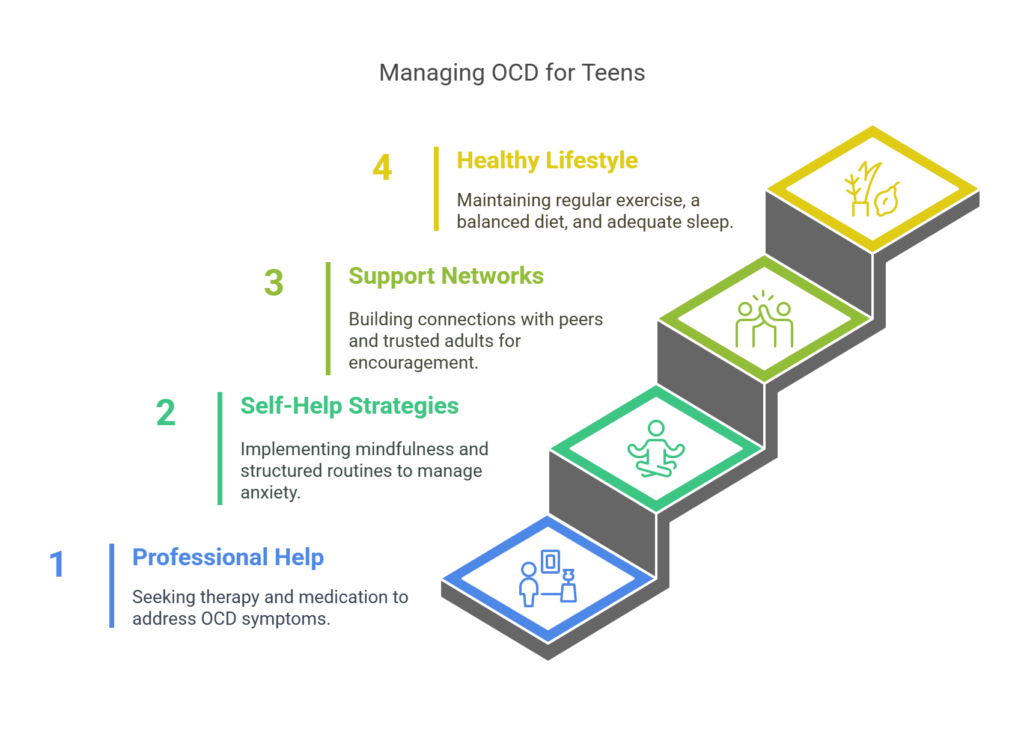
Being a teenager comes with its share of challenges, and for those dealing with issues like Obsessive-Compulsive Disorder (OCD), it can feel like an additional layer of complexity. In this section, we’ll explore some straightforward yet powerful coping strategies to empower teens in managing the demands of everyday life.
By incorporating these approaches into their routines, teens can enhance their resilience and embrace a more balanced and empowered way of living.